In Aimgod: Habits you don't do, live now
Track What You Don't Do: The Habit Nobody Puts in a Planner
Track what you don't do: a habit can be a thing you choose not to do. Didn't smoke, alcohol-free day, no phone before the first task. On paper and in Aimgod.
 By Oleksandr Sendziuk, founder of Aimgod · · 6 min readFollow on LinkedIn ↗
Open any habit tracker. Workout, read, meditate, water, steps. Things you did.
Now think about the habit that actually runs your day. Chances are it's a thing you do without deciding, and the win would be a day you didn't do it. No tracker has a row for that. I think it's the most important row there is, so this is how I track what you don't do, on paper and in Aimgod.
A habit can be a thing you don't do
"Didn't smoke." "Alcohol-free day." "No phone before the first task." "Bed before midnight." "Didn't eat out of boredom." "No-spend day."
Each one is a decision you make every day. Each one has a moment when it's won or lost. That makes it a habit, the same as the gym, and it deserves the same line in the plan, with a time.
The shift is small and it's everything: you stop resisting something all day and start completing a task. At 22:00 you look at "Didn't smoke". Didn't? Tick. That's not an absence. That's a thing you did.
How to set it up on paper
You don't need an app for this. A notebook works.
- 01Pick one. Not four. The one that runs your evenings or your mornings.
- 02Write it as a thing you did. "Didn't smoke", not "stop smoking". "Alcohol-free day", not "drink less".
- 03Give it a time. The moment it's decided. Smoking and drinking: late evening, 21:00 or 22:00. Phone: the hour your first task starts. Bed: the bedtime you want.
- 04Put it in tomorrow's plan tonight. Tomorrow morning the decision is already made.
- 05Tick it at its hour. Didn't? Tick. Did? Leave it open. No notes, no guilt, bed.
- 06Repeat it every day for a month. Then count the ticks.
A page of ticks is clarity. You'll see the real rate, not the one you imagined. In my own account, over the last three months, a task with a time gets done 69% of the time and one without a time 48%. The time is not decoration. It's the difference.
How to set it up in Aimgod
The same thing, with the counting done for you.
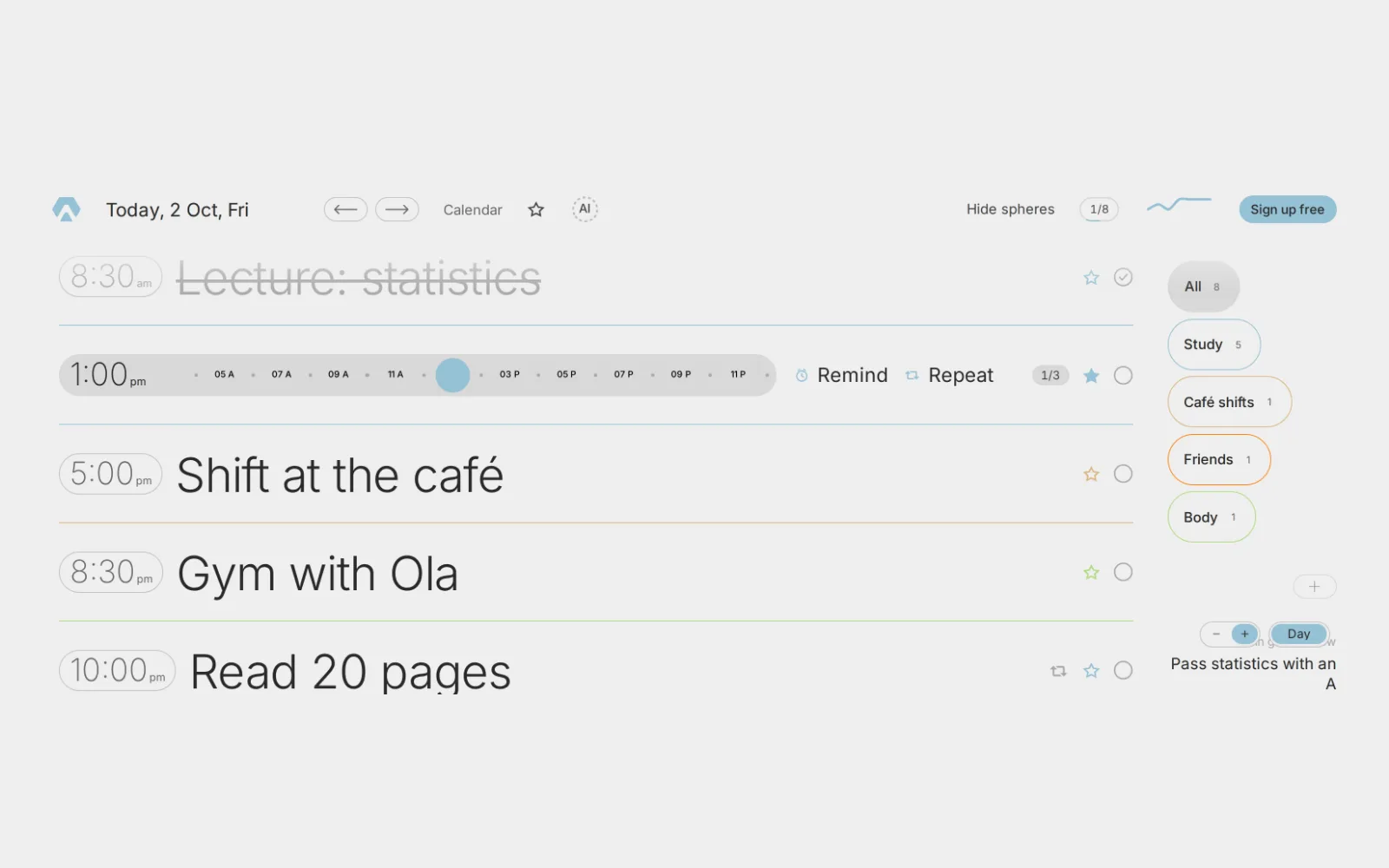
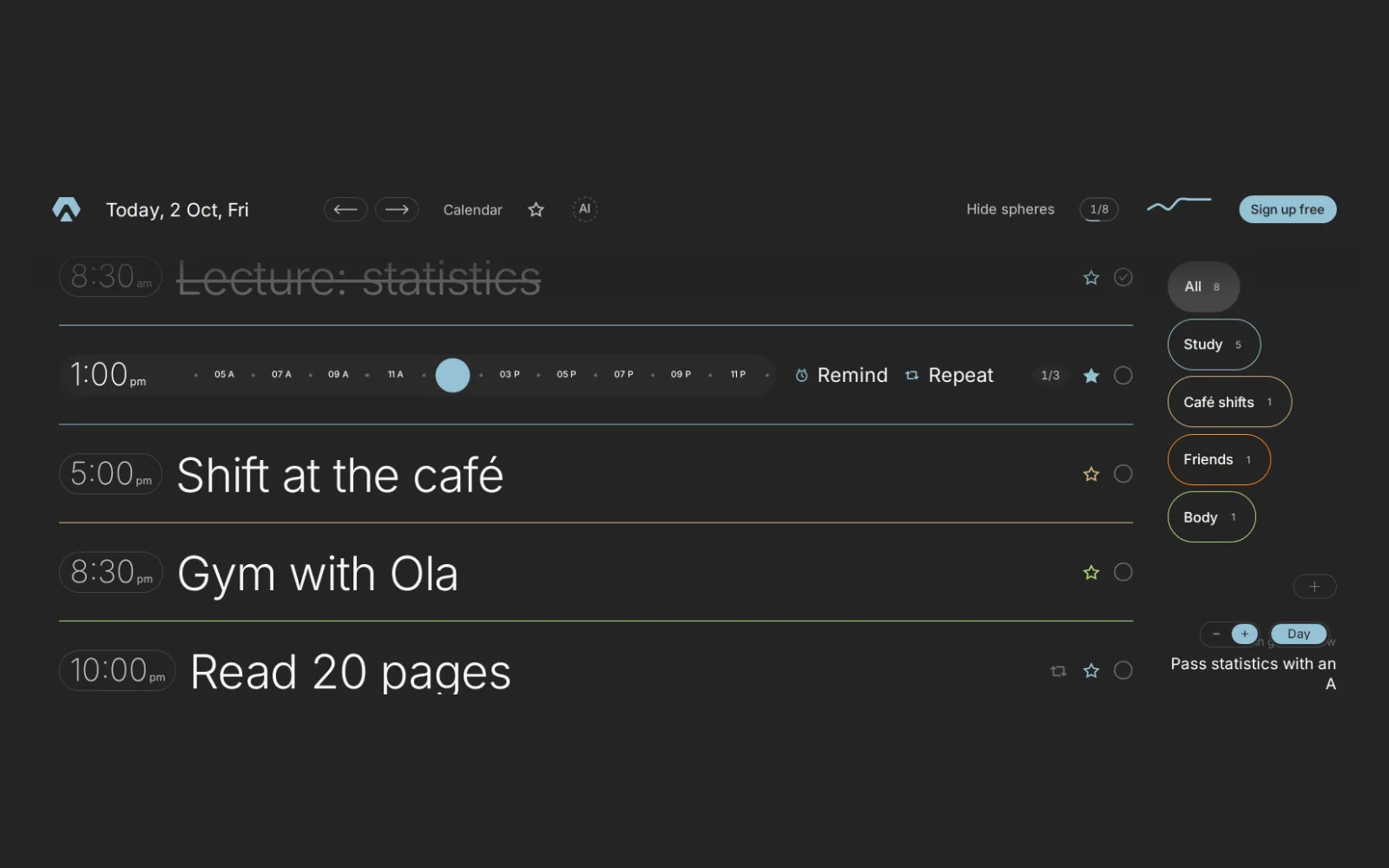
- 01Add the task: "Didn't smoke".
- 02Tap its number and give it a time: 22:00.
- 03Open it and set the repeat: every day.
- 04From tomorrow it comes back on its own, at 22:00, in the time order of the day.
- 05At 22:00, tick it or don't.
That's it. Nothing to configure. Aimgod doesn't know it's a thing you didn't do, and it doesn't need to. A repeating task is a habit, and every habit gets its own Habit tab.
The picture is the point
Tap the repeat icon on "Didn't smoke" and you get the Habit tab: the days in a row, the rate over four weeks, eight weeks of bars, the day of the week it usually slips, and one plain suggestion.
This is why I built the counting into the app instead of leaving it on paper. The picture gives clarity. Clarity gives strength: eleven days in a row make the twelfth evening easier. Strength gives freedom. The thing is still in the cupboard. You just don't need it.
I'm going to say it once and move on: this is my personal experience, not a method for everyone. If a habit has become something you can't control, the right next step is a doctor or a counsellor, not a planner.
Six habits of not doing, with their hours
| Habit | Time | Why that hour |
|---|---|---|
| No phone before the first task | 9:00 | Won or lost in the first hour |
| Alcohol-free day | 21:00 | The glass usually pours after dinner |
| Didn't smoke | 22:00 | The evening is where it lives |
| Bed before midnight | 23:30 | Late enough to be honest |
| Didn't eat out of boredom | 22:00 | The fridge opens at night |
| No-spend day | 20:00 | Shops are closed, the apps aren't |
Pick one. The two I'm working on right now, and how they go, are in stronger than your habit and bed before midnight.
What to do with the first bad week
The first week usually has two or three ticks out of seven. Good. That's the real number, and you couldn't see it before.
Don't make the habit bigger or add a second one. Look at which days slipped. If it's always Friday, plan Friday: a walk after dinner, a call, an early night. That's an if-then plan, and it's how a 3 out of 7 becomes 5 out of 7. The Habit tab in Aimgod names the weak day for you.
FAQ
Can you track a habit by not doing something?
Yes. Write it as a thing you did ("Didn't smoke"), give it a time at the end of the day, and tick it then. On paper or in any planner. In Aimgod a repeating task with a time is enough, and the Habit tab counts the days.
Why give a habit of not doing a time?
Because the habit has an hour when it's decided. The time puts the decision in your plan before that hour comes. In my own account tasks with a time get done 69% of the time, tasks without one 48%.
How many of these should I track at once?
One. When it holds for about a month, add the next. Three at once means three weak evenings a week instead of one.
What if I did the thing?
Leave the line open and go to bed. Tomorrow the line is back. One day is a gap in the picture, not the end of the picture.
One calm letter a week
A short read on planning, habits and focus, from the founder of Aimgod. No spam, unsubscribe anytime.
We only use your email to send the letter. Privacy
Oleksandr Sendziuk is a product designer with 22 years in SaaS and the founder of Aimgod. He has studied personal growth, psychology and productivity for over a decade, and has been building the system behind Aimgod since 2013.
Follow the build on LinkedIn ↗