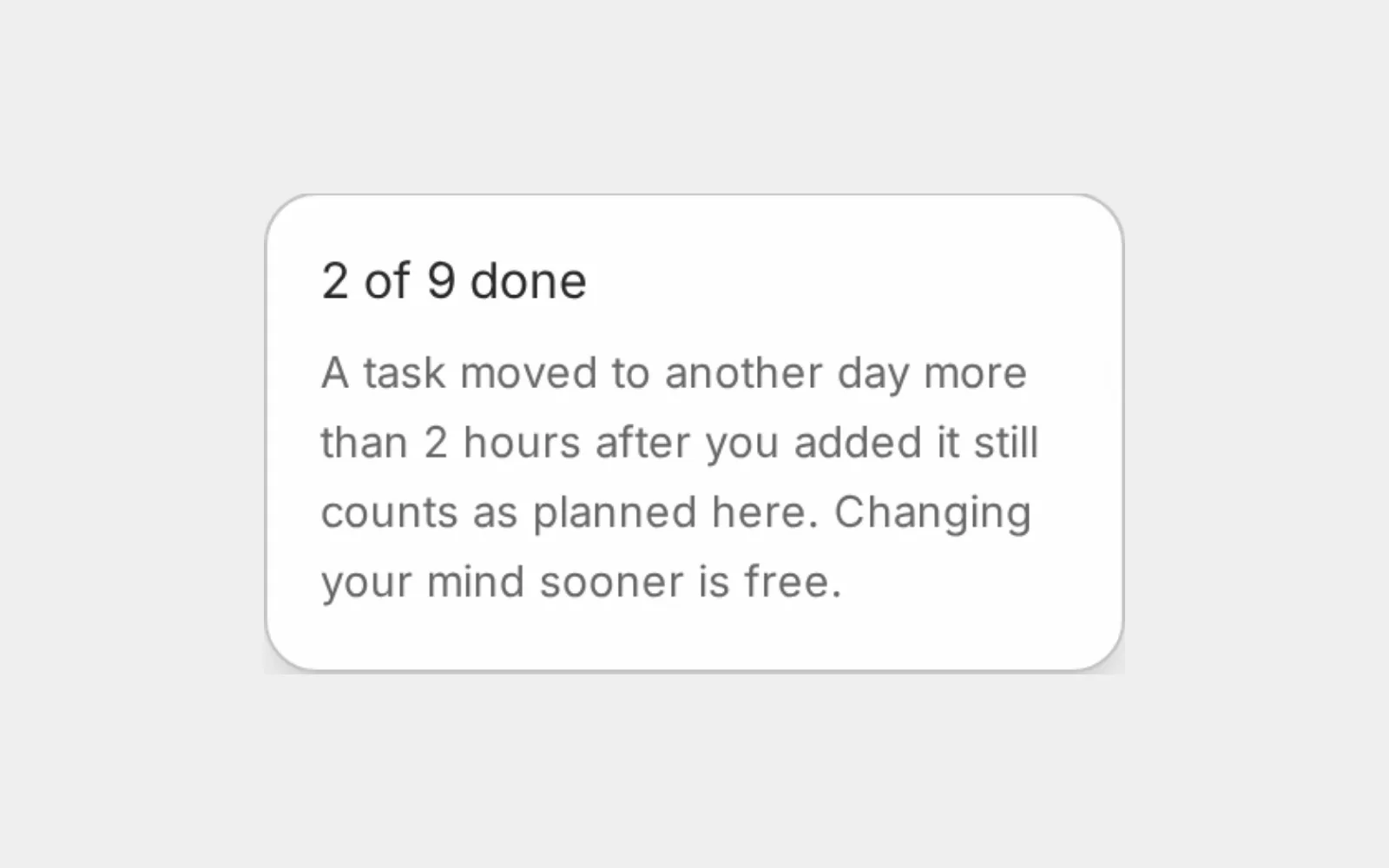
In Aimgod: The day view, live now
Why I Built Aimgod, a Calm Day Planner
Why I built Aimgod, a calm day planner: I tried the big productivity apps as a designer, none fit, so I spent 13 years removing what a day does not need.
 By Oleksandr Sendziuk, founder of Aimgod · · 7 min readFollow on LinkedIn ↗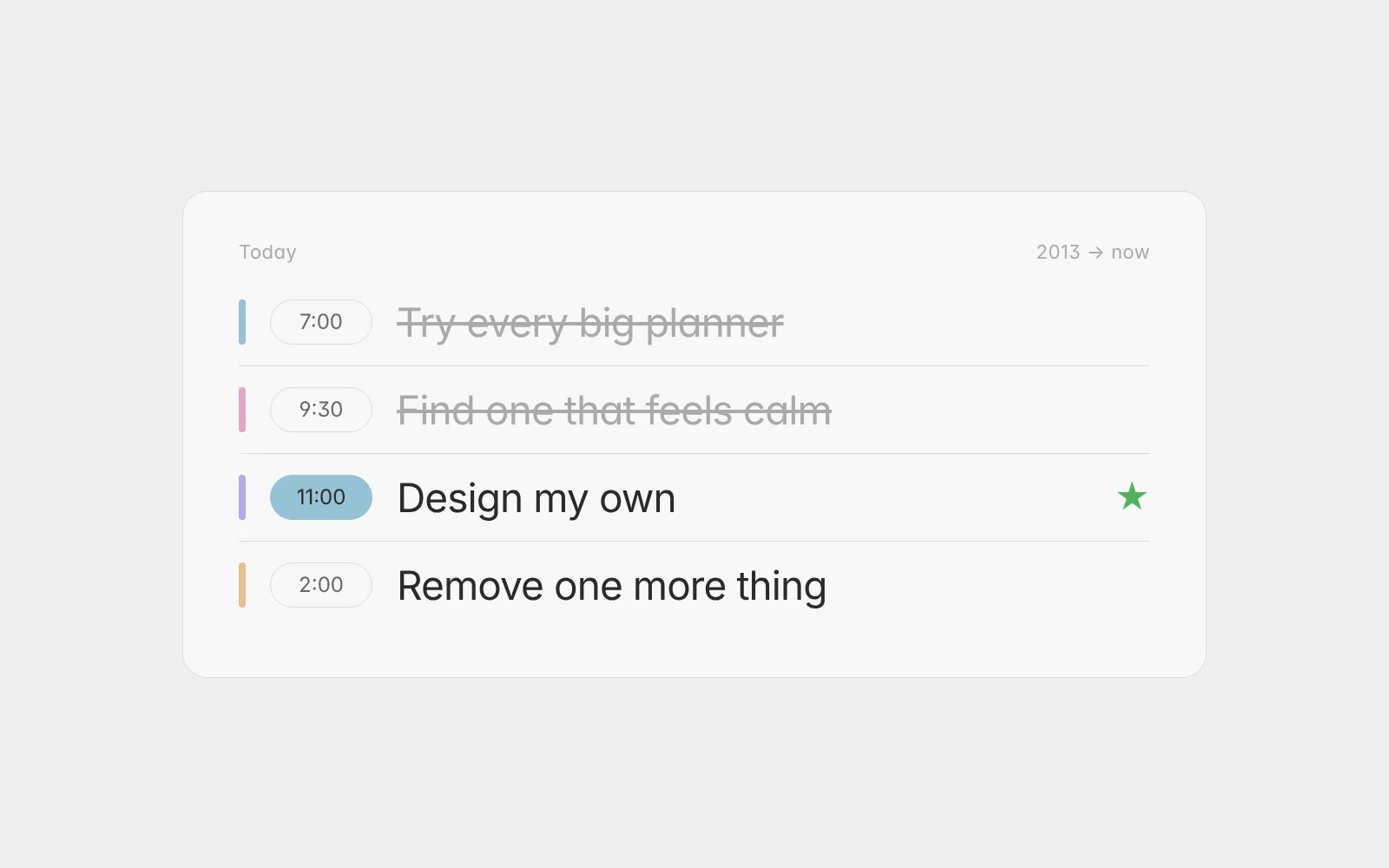
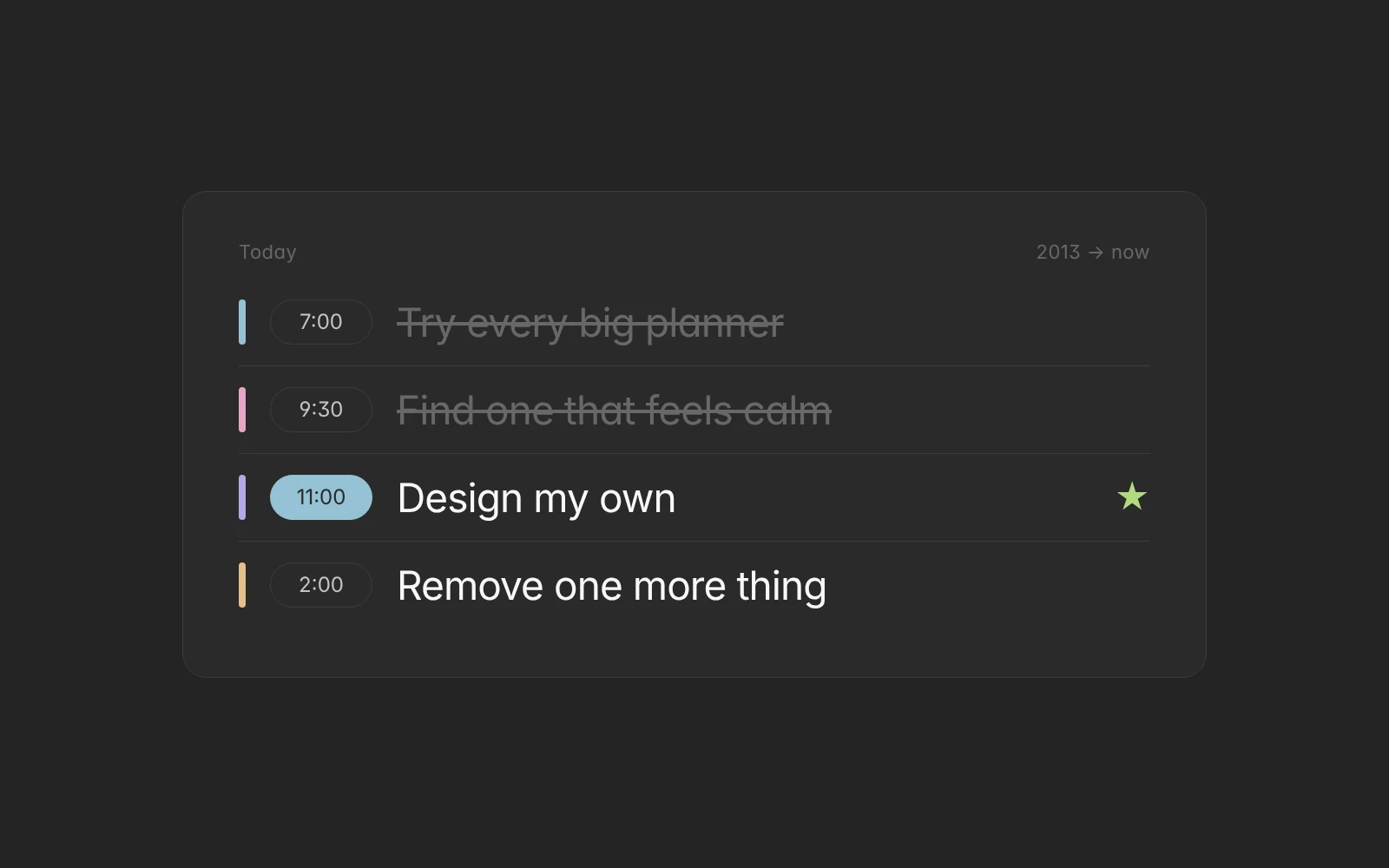
People sometimes ask why I build a planner when the world already has so many. Fair question. The short answer: I went looking for a calm day planner, tried the biggest names in personal productivity one by one, and none of them felt right to me as a designer. So I started my own.
That was 2013. Aimgod has been with me ever since, through one long design, a full rebuild, and a new version that keeps evolving. This post is the longer answer: what I was looking for, what I kept, what I threw away, and why the result looks so quiet on purpose.
I tried them all first
Before building anything, I did what designers do. I studied the market. I took the giants of personal productivity, signed up, moved my real life into them, and lived there for a while. Lists, projects, labels, boards, timers, streaks, points. I gave each one an honest chance.
Some of them are very good at what they do. But every time I hit the same wall. The tool wanted me to manage the tool. Badges asking for attention, red counters reminding me what I failed yesterday, ten ways to organise a task before I could do it. My day disappeared under the structure built to hold it.
I wanted the opposite. One short list for today. A clear sense of when things happen. Nothing shouting at me.
Here's the part people don't expect. If one of those apps had satisfied me, Aimgod wouldn't exist. I would have happily built something else instead. A health system with dashboards, maybe, or a tool for personal finance. I didn't set out to make a personal productivity app because I love the category. I made one because I couldn't find the one I needed, and planning my day is something I do every single morning.
Thirteen years, in short
The history is simple. I started from zero in 2013. I designed the product, then spent a few years building it. That first design lived for about ten years, which in software is a very long life. It worked, I used it daily, and it taught me what a planner actually needs.
Then I started again with a new design. Not a facelift, a rethink, using everything those ten years showed me. That design keeps evolving. This year it got a productivity dashboard, and since 1 October 2026 a first version of habit formation too.
Along the way I read a lot. Books on focus, psychology, business biographies, hours of podcasts. I don't think any single source gave me the answer. What helped was putting all of it next to my own experience: what I noticed in my own days, where my plans broke, what made me close an app and never open it again. Some of the ideas inside Aimgod I never read anywhere. They came from using my own product every day and getting annoyed at the same small things until I fixed them.
The time pill: two taps instead of typing
The best example is the time pill. In most planners, putting a time on a task means opening a picker, scrolling hours, scrolling minutes, confirming. Maybe typing "14:30" into a field. Small friction, met many times a day, is how good habits quietly die.
In Aimgod you tap the time pill on a task, it turns into a ruler, you slide, and it snaps to 15 minutes. Two taps, about two seconds. Done.
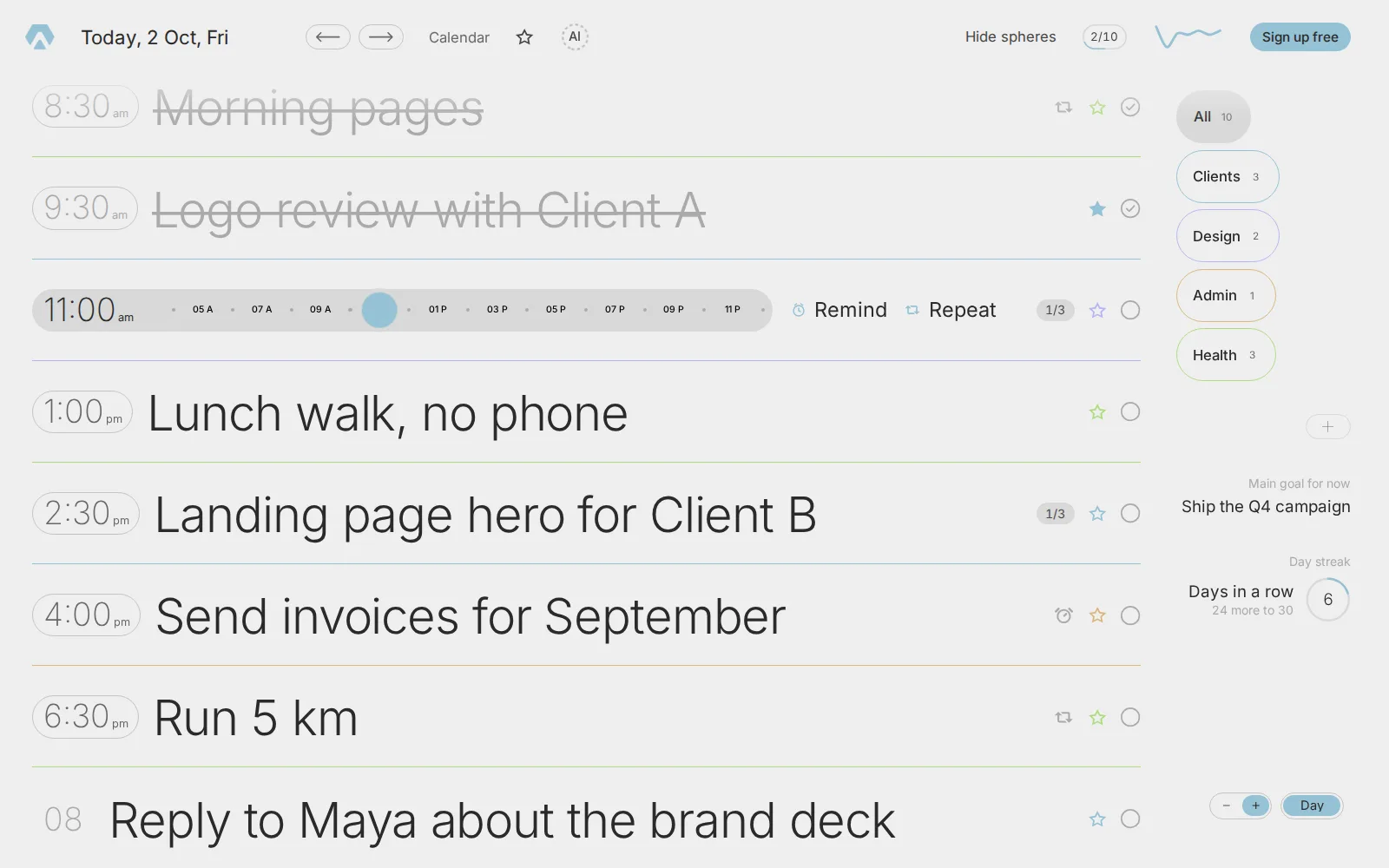
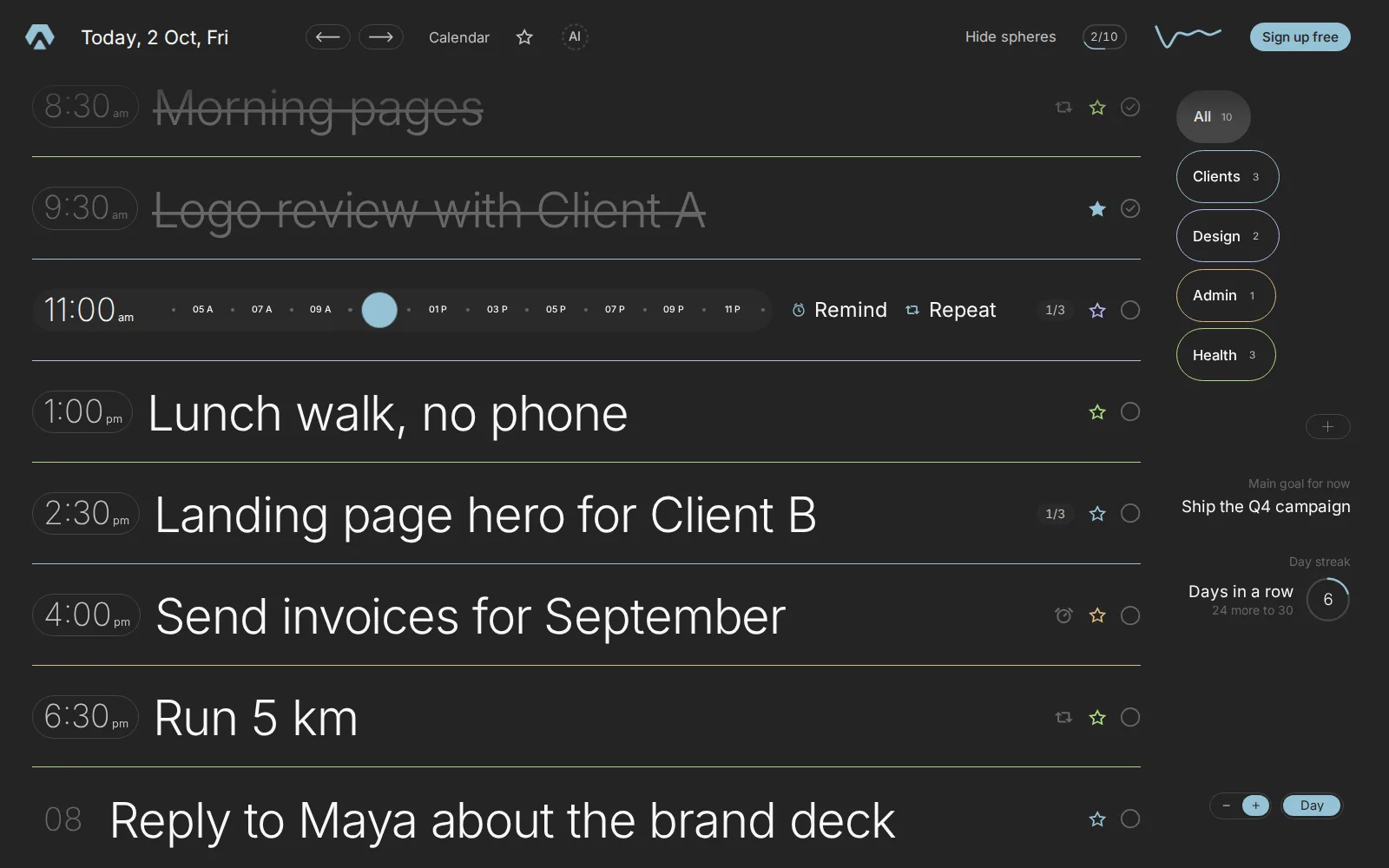
That's the kind of detail I care about most. A time on a task is what turns a list into a day, and if setting it takes two seconds, you actually do it. If you've ever felt your list was a wish rather than a plan, the problem is often missing times. I wrote more about that in how to plan a day you can actually finish.
The hardest part is removing
Here's what nobody tells you about designing a minimalist planner app. Adding is easy. Every feature has a good argument behind it. Keep saying yes and you get the same crowded tool I was running away from.
The hardest part of my work is removing. Getting rid of what isn't needed so that what is needed can speak. I spend more time deciding what stays out than building what goes in. A screen is finished for me when there's nothing left to take away without losing something real.
So in Aimgod:
- No badges, no red counters, no overdue alarms. A planner should help you start the day, not greet you with yesterday's failures.
- Spheres instead of a forest of labels. Color lines for the parts of your life, ten colors, work by day and night. Show them full, compact or hidden, filter in one tap.
- Subtasks that show progress right on the row, so you see how far along something is without opening it.
- Light by day, dark by night, without you thinking about it.
- Large type on purpose. You can read your day from about three meters away, on a second monitor or a TV in the studio.
That last one is a designer's habit. I wanted to glance at it from across the room and know exactly what's next. That's also why I think of Aimgod as a planner app for designers and anyone who works visually: it respects the eye.
What makes a calm day planner calm
Calm isn't a color palette. It's a set of decisions about what the app is allowed to do to your attention.
A calm day planner doesn't compete with your work. It shows you today, the time each thing happens, and which part of your life it belongs to. Then it gets out of the way. When something didn't get done, it doesn't punish you. You move it and carry on. If yesterday went sideways, today is still a fresh start without guilt.
The same rule applies to the newer parts. The AI circle lets you speak, type or answer a few taps and ask it to plan your day, and every change is shown before it lands. Nothing moves behind your back. It also works with Claude: connect once, then plan in plain words, like "Move the invoices to Friday." The dashboard shows done versus planned for the week, month and year, without points or leaderboards. Habits get a simple verdict and one suggestion, not a wall of charts. If you want to know how long a habit usually takes to settle, I wrote about how long it really takes to form a habit.
Every feature has to pass the same test. Does it make the day clearer, or does it make the app louder?
Who it's for
I built Aimgod for myself first. But the people it fits best are people a lot like me. Freelancers, designers, founders, makers, anyone who juggles clients, their own projects, their body and their family in one day and wants to see all of it in one quiet place.
If you love deep project hierarchies and dozens of filters, there are great tools for that, and I mean it. If you want one short list for today with a time on each task and nothing shouting at you, a personal productivity app built around the day might be what you've been missing. A minimalist planner app isn't about fewer features. It's about every feature earning its place.
There's a live demo with no sign up at aimgod.com/try, so you can see it before you decide anything. I also build it in public and share notes on LinkedIn as it grows.
Still removing
Thirteen years in, the work hasn't changed much. I use the planner, I notice what gets in the way, and I take it out. New things arrive too: goals, a lifelong focus, three horizons of planning that connect a day to a life. But they only arrive when they make the day calmer, not busier.
That's why I built a calm day planner. Not because the world needed another app, but because I needed a quiet place to decide what my day is for. If you need one too, it's here.
FAQ
What makes Aimgod a calm day planner?
There are no badges, red counters or overdue alarms. You get one short list for today with a time on each task, spheres for the parts of your life, light and dark themes that follow the day, and large type you can read from across the room.
Is Aimgod a good planner app for designers?
I'm a designer and built it the way I wanted to work: visual, quiet, with large type for a second monitor and two taps to set a time. It suits designers and anyone who works visually, though it isn't limited to them.
How is it different from other personal productivity apps?
Most list apps are built around projects and labels. Aimgod is built around the day: what happens today, at what time, and in which part of your life. The rest is removed on purpose so the day stays clear.
One calm letter a week
A short read on planning, habits and focus, from the founder of Aimgod. No spam, unsubscribe anytime.
We only use your email to send the letter. Privacy
Oleksandr Sendziuk believes the hardest part of design is not adding, but knowing what to remove.
Follow the build on LinkedIn ↗